AI receptionist vs answering service: a contractor's guide

A live answering service puts a trained person on every call, which is best for upset callers and unusual situations but is limited by the script the operators are given. An AI receptionist answers instantly at any hour and can book straight into the schedule, but handles surprises less gracefully than a person. Most contractors end up combining options: a person in the office by day, and an answering service, an AI receptionist or missed-call text-back for overflow and after hours. Alvin does not answer calls. Alvin handles what comes after the call: the booking, the follow-up message and the job record.
On this page
The five options for calls you cannot take
- Voicemail. The caller hears a greeting and leaves a message, or hangs up and tries the next company.
- A live answering service. Operators at a call center answer as your company, usually handling many businesses at once.
- An AI receptionist. Software answers, talks with the caller and records or books the request.
- Missed-call text-back. The call goes unanswered, and a text goes out within seconds asking how you can help.
- An in-house person. Your own office staff or dispatcher, who knows the customers, the crews and the calendar.
AI receptionist vs answering service: comparison table
No prices here on purpose. Plans and per-minute rates change, so get current quotes from each vendor.
Scroll sideways to see every column.
| Option | Does well | Does poorly | Best fit |
|---|---|---|---|
| Voicemail | Free, simple, already set up | Many callers will not leave a message. Nothing happens until someone listens. | Existing customers who know you will call back |
| Live answering service | A human voice. Calms upset callers. Copes with odd requests. | Operators know only the script. Detail can be lost in the message. Busy periods can mean hold time. | After-hours emergencies and shops where callers expect a person |
| AI receptionist | Answers every call at once, any hour. Consistent questions. Can book into the schedule if connected to it. | Struggles with heavy accents, bad lines and requests outside its setup. Some callers dislike talking to software. | High call volume, routine bookings, overflow |
| Missed-call text-back | Fast and cheap to run. Meets callers who prefer texting. | Does nothing for landline callers. Still needs a person or tool to continue the conversation. Texting rules apply. | A backstop behind every other option |
| In-house person | Knows the business. Can quote, schedule and solve problems in one call. | One person, one call at a time. Lunch, sick days, evenings and weekends are uncovered. | Business hours, and any shop large enough to staff the phone |
General information, not legal advice. Call recording, automated calling and business texting are regulated, and the rules vary by state. Check the rules that apply to you, and see the overview of texting rules for contractors.
What to look for in an answering service for contractors
A general answering service takes a name and number. A contractor needs more than that from a call.
- Emergency handling. A clear rule for what counts as an emergency in your trade, and a way to reach the on-call person that has been tested at 2am.
- The right questions. Address, what is happening, how long, whether it is getting worse, owner or tenant, how they found you.
- Where the message lands. An email to a shared inbox is workable. A job created in your field service app is better. A text to the owner's personal phone is a single point of failure.
- Booking or message only. If the service books, confirm what calendar it sees and what it does when the day is full.
- Call records. Recordings or transcripts you can review, so you can coach the script.
How to choose for your shop
- Count your missed calls. Pull a month from your phone system: how many unanswered, at what hours, on which days.
- Sort them. Emergencies, new work, existing customers, vendors and spam. The mix decides what you need.
- Cover the daytime gap first. If calls are missed at 10am because the office is on another line, the fix is overflow, not after-hours service.
- Decide what after-hours means. Take a message for the morning, or wake the on-call person? Write the rule down by problem type.
- Test with your own calls. Call as an angry customer, as someone with water coming through a ceiling, as a price shopper and as a vendor. Listen to what happens.
- Add text-back as a backstop. Some calls will still be missed. A prompt text catches a share of them. The wording is in the guide to missed-call text-back.
- Review after 30 days. Read the messages, listen to ten calls, and check how many turned into booked jobs.
What happens after the call
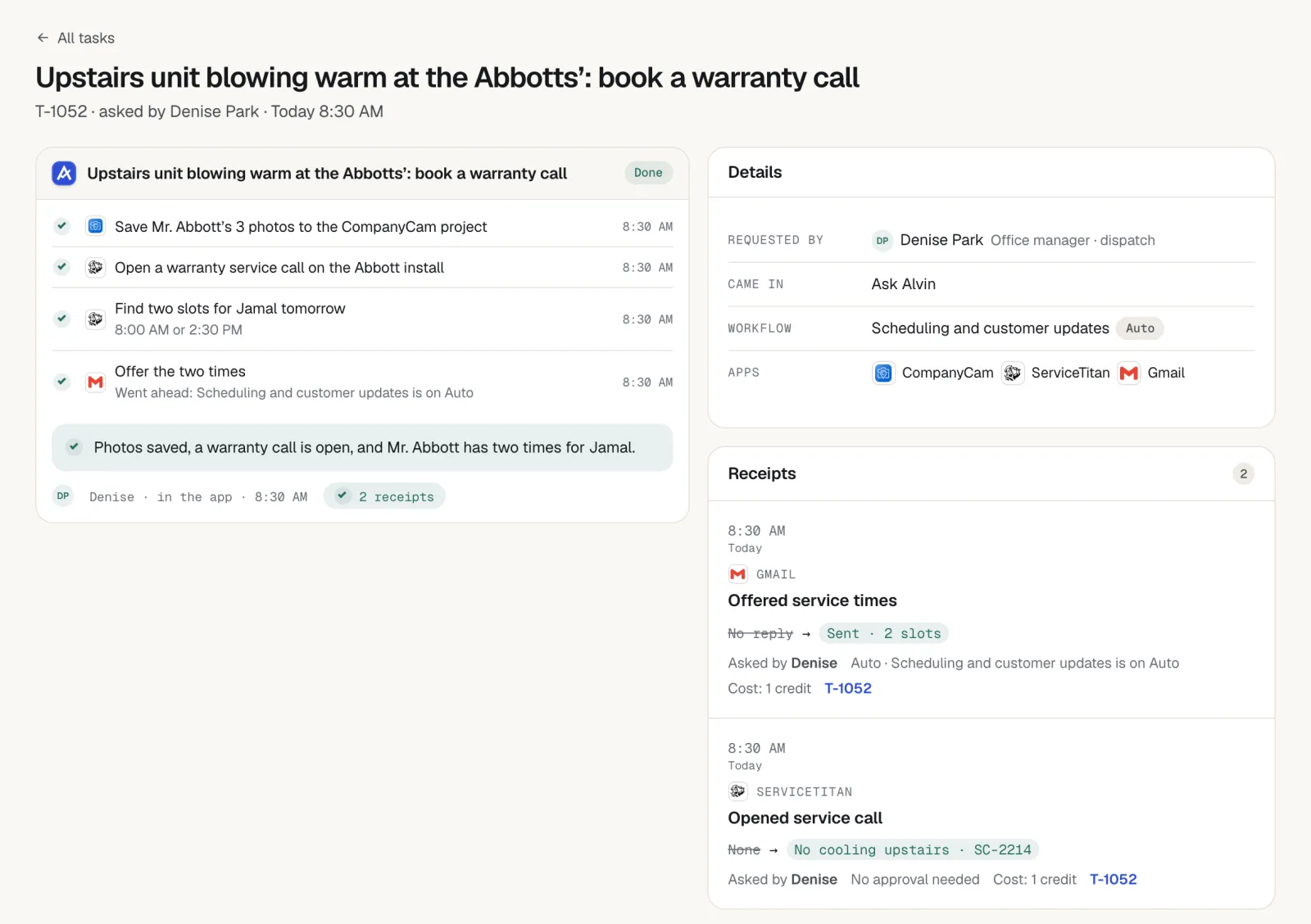
Answering is only the first step. A message that says "Dave Smith, no hot water, call back" has created five more tasks:
- Find or create the customer in the field service app
- Check for an existing job, a warranty or a maintenance plan
- Book the visit and tell the technician
- Send the customer a confirmation with the arrival window
- Follow up if nobody reached them
When those tasks wait for Monday, the answered call was not worth much.
What Alvin handles and what stays with you
Alvin has no phone line today. Alvin does not answer calls or make them. Alvin works alongside whichever call option you use, and picks up from the message that option produces.
| Alvin does | You do |
|---|---|
| Reads the answering service or receptionist message when it is forwarded by email, and finds or creates the customer | Choose and run the call option: staff, service, AI receptionist or text-back |
| Checks the customer's history, open jobs and maintenance plan | Decide what counts as an emergency and who is on call |
| Proposes a slot and books the job in your field service app once approved | Own the schedule and dispatch |
| Drafts the confirmation or follow-up email or text from your own accounts, held for approval, with opt-out and quiet-hours rules applied | Approve what goes to customers |
| Lists unreturned messages in the morning briefing | Make the callbacks that need a voice |
| Keeps a receipt of each step: who asked, who approved, what changed | Talk to the customer |
Questions to ask before you sign
- How is it billed: per minute, per call, per month? What counts as a billable call?
- Can I change the script myself, and how quickly does a change take effect?
- How does an emergency reach my on-call person, and what happens if they do not pick up?
- Does it connect to my field service app, and what exactly gets written there?
- Can I hear recordings or read transcripts of every call?
- For an AI receptionist: how does a caller reach a person, and does it say it is automated?
To size the problem with your own call log, use the free missed call calculator.
Frequently asked questions
Is an AI receptionist better than an answering service?
Neither is better for every shop. An AI receptionist answers instantly, never puts a caller on hold and can book routine jobs directly. A live answering service handles upset callers and unusual requests more gracefully. Many contractors use one for overflow and the other for after-hours emergencies.
What is the best answering service for contractors?
The best one for your shop is the one that handles your emergencies correctly, asks the questions your trade needs and puts the result where your team will see it. Test candidates with realistic calls before signing. Compare current pricing and terms on each vendor's site.
Do customers mind talking to an AI receptionist?
Some do and some do not. Callers with a simple request often just want the appointment booked. Callers who are stressed or have a complicated problem tend to want a person. Offer a clear way to reach one.
Is missed-call text-back enough on its own?
It helps, but it works only for callers on mobile phones, and someone still has to carry on the conversation after the first text. It is most useful as a backstop behind a person, a service or an AI receptionist. Texting rules on consent and opt-out apply.
Does Alvin answer the phone?
No. Alvin has no phone line today and does not answer or make calls. Alvin handles the work after a call or message: creating the job, booking the visit, drafting the follow-up email or text for approval and keeping the record.
Whoever answers, the follow-through gets done.
Join the waitlist and we will set Alvin up with your apps, so every call message turns into a booked job and a follow-up.