After hours plumbing calls: how to handle emergency calls
Plumbers handle after hours calls with four things decided in advance: a triage rule that separates true emergencies (active leak, sewer backup, no water) from jobs that can wait until morning, an on-call rotation, a stated after-hours fee, and a short script that tells the caller what to do first. Someone or something still has to answer the phone. Alvin has no phone line, so Alvin covers the written side: the follow-up message, the job record and the morning summary of overnight requests.
On this page
How to triage an after-hours plumbing call
Whoever answers needs a rule that takes less than a minute to apply. Three questions sort most calls: Is water or sewage going where it should not, right now? Can it be stopped at a valve? Is there a working toilet and water in the home?
Scroll sideways to see every column.
| What the caller says | Category | Response |
|---|---|---|
| Burst pipe, water coming through a ceiling, water heater tank leaking and cannot be shut off | Emergency | Shut-off instructions now, dispatch on-call |
| Sewage backing up into a tub or floor drain | Emergency | Stop using water, dispatch on-call |
| No water to the whole house | Urgent | Check for a utility outage first, then dispatch or first slot in the morning |
| Leak stopped by closing a valve | Can wait | First slot in the morning |
| No hot water | Can wait in most cases | Morning, sooner for households with infants, elderly or medical needs |
| One clogged toilet or sink, other fixtures work | Can wait | Next business day |
| Dripping faucet, running toilet, estimate request | Routine | Normal scheduling |
| Smell of gas | Not yours first | Tell the caller to leave the building and call the gas utility or 911 |
Write your own version and give the on-call plumber the right to move a call up a category.
What to tell the customer to do first
The first minute of the call can save the customer thousands in water damage. Put these steps in your script and in your text reply.
- Shut off the water. Use the fixture's own valve if the leak is at a toilet or sink. Otherwise close the main shut-off, usually where the line enters the house or at the meter.
- For a leaking water heater, close the cold supply valve on top of the tank. Turn a gas unit's control to off or pilot, or switch off the breaker for an electric unit.
- For a sewer backup, stop running water everywhere in the house: no flushing, no laundry, no dishwasher.
- Keep water away from electricity. If water is near outlets or the panel, stay out of it.
- Open a low faucet to drain pressure after the main is closed, and move what can be moved out of the water.
- Take photos. They help the plumber and any insurance claim.
Setting up an on-call rotation
- One primary, one backup. Rotate weekly so everyone knows whose week it is. The backup takes the call if the primary does not respond in a set time, for example 10 minutes.
- Pay for carrying the phone. A flat on-call stipend for the week plus pay for each call-out is a common structure. Wage and overtime rules apply, so check them for your state.
- Stock the truck. The on-call truck carries the parts that end most night calls: caps, couplings, repair clamps, supply lines, a drain machine.
- Define "stabilize" and "repair". At 2am the goal is often to stop the damage and come back in daylight. Say so in the policy.
What to charge for after-hours calls and how to state it
Shops use one of three structures: a flat after-hours dispatch fee added to normal pricing, a higher diagnostic fee at night with normal repair prices, or an after-hours multiplier on the price book. A flat fee is the easiest to say on the phone. As an example only, a shop might add a $150 emergency dispatch fee to its normal flat rate prices.
Whatever you charge, state it before the truck rolls and get a yes.
Wording: "We can have a plumber there tonight. After-hours service has a $150 emergency dispatch fee on top of the repair, and the plumber will give you the repair price before starting. Or we can book you first thing at 7:30 with no after-hours fee. Which would you like?"
Offering the morning slot matters. Callers who choose the fee feel they made the choice. Put the fee on its own line on the invoice, and build it from real costs using the method in plumbing flat rate pricing.
Options for answering the phone after hours
Scroll sideways to see every column.
| Option | How it works | Watch for |
|---|---|---|
| On-call phone | The office line forwards to the on-call plumber | Calls missed while driving or under a house, and tired plumbers |
| Answering service | Live operators follow your triage script and page on-call for emergencies | Script quality. Review their notes every morning |
| AI receptionist | Software answers, asks triage questions and books or escalates | How it handles a panicked caller. Test it yourself at night |
| Missed-call text-back | The phone system texts a missed caller automatically | A text does not stop a burst pipe. Use it as a backup |
| Voicemail with an emergency number | The greeting gives the on-call number and shut-off advice | Many callers hang up and dial the next plumber |
The trade-offs between the two outsourced options are in AI receptionist vs answering service. Most shops pair a live answer for emergencies with a text-back for everything else.
The morning after
Overnight requests arrive in pieces: an answering service email, a web form, two voicemails, a text to the on-call plumber. By 7am the office needs one list: who called, what they need, what was promised, and who is going.
Every request should get a written reply that morning, including the ones that can wait. Example: "Hi Mr. Patel, we got your message about the kitchen sink last night. We can be there today between 10 and 12. Reply YES to confirm or call us at [number]."
On-call pay rules and rules for business texts vary by state. Check the ones that apply to you. This article is general information, not legal advice.
What Alvin handles and what stays with you
| Alvin does | You do |
|---|---|
| Reads overnight requests that arrive in writing (answering service emails, web forms, messages in your field service app) and sorts them with your triage rules | Answer the phone, or pay a service to. Alvin does not answer or make calls |
| Drafts the follow-up email or text to each customer, held for approval, with quiet-hours and opt-out rules applied | Approve the messages and make the dispatch decision |
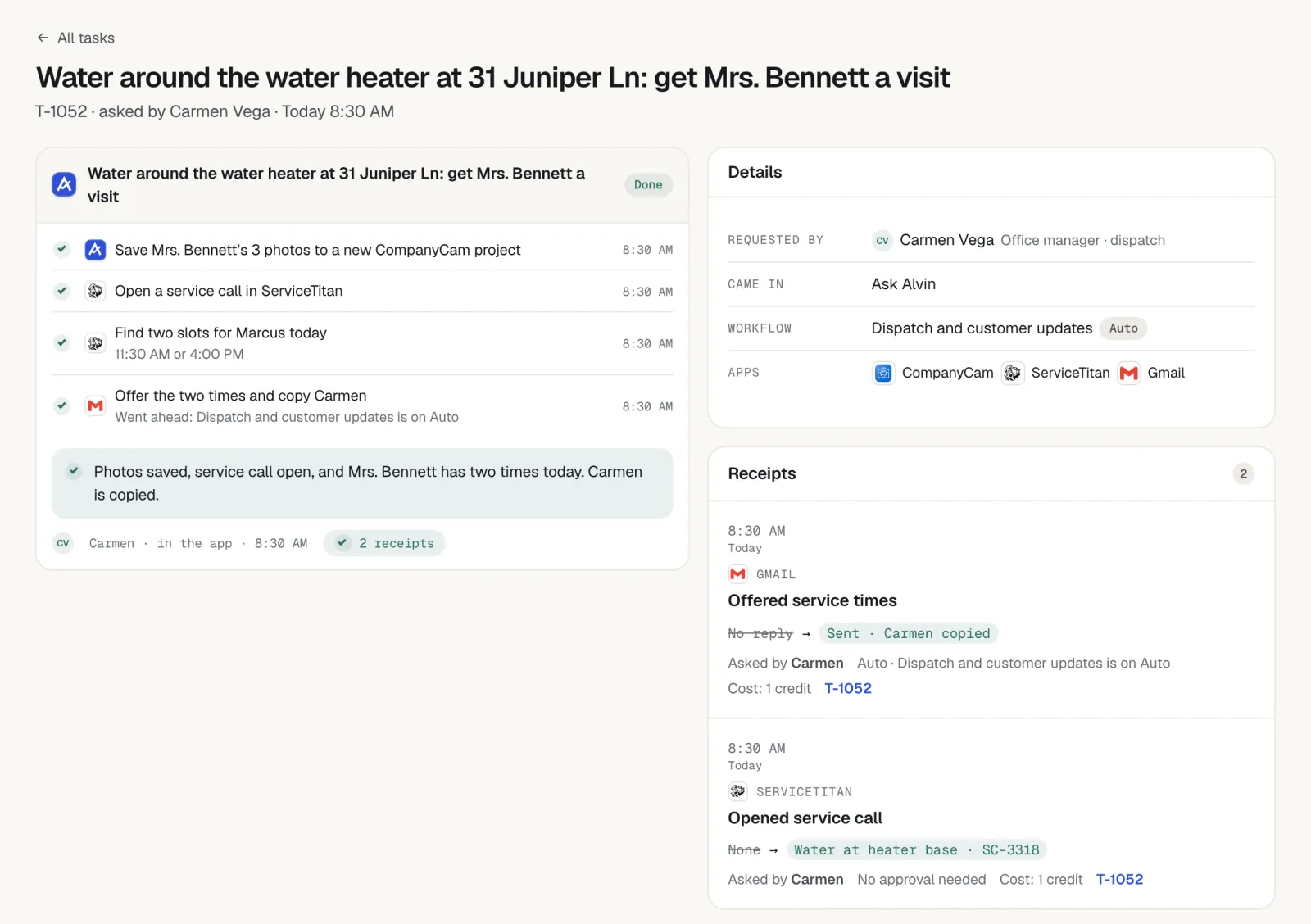
| Creates or updates the job record with what the customer said and what was promised | Diagnose and repair |
| Puts the overnight list in the morning briefing: who, what, how urgent, who is assigned | Set the rotation, the fee and the triage chart |
| Drafts the invoice with the after-hours fee as its own line, for approval, and keeps a receipt of each step | Approve the invoice. Payment goes from the customer to you |
Frequently asked questions
What counts as a plumbing emergency?
A plumbing emergency is a problem where waiting causes damage or makes the home unusable: a burst pipe, a leak that cannot be shut off, sewage backing up into the house, or no water at all. A leak that stops when a valve is closed, a single clogged fixture or no hot water can usually wait until morning.
How much do plumbers charge for after hours calls?
It varies by shop and market. Common structures are a flat after-hours dispatch fee on top of normal prices, a higher diagnostic fee, or a multiplier on the regular rate. Whatever the structure, the fee should be stated on the phone and agreed to before a plumber is sent.
How do plumbing companies answer the phone at night?
The main options are forwarding the line to an on-call plumber, a live answering service that follows a triage script, an AI receptionist, or voicemail with an emergency number. Many shops add an automatic text reply to missed calls as a backup.
What should I tell a customer with a burst pipe before the plumber arrives?
Tell them to close the main water shut-off, usually where the line enters the house or at the meter. Then open a low faucet to drain pressure, keep clear of water near outlets or the electrical panel, and take photos of the damage.
How should a small plumbing shop set up an on-call rotation?
Rotate one primary and one backup plumber weekly, with a set time for the backup to step in if the primary does not respond. Pay for being on call and for each call-out, stock the on-call truck for common night repairs, and give the plumber time to rest after a late call.
Wake up to one list, not five inboxes.
Alvin gathers the overnight requests, drafts the replies and puts the list in your morning briefing. See what Alvin does for plumbing shops.