Pest control service agreement: a contract template checklist
A pest control service agreement should state which pests are covered and excluded, how often you visit, what the first visit includes, the re-service guarantee, what the customer must do, the term, how renewal and cancellation work, the price and billing, and any disclosures your state requires. The checklist below lists each clause with sample wording to adapt. Alvin fills in the agreement from the job record, sends it once approved, and tracks signatures and renewal dates.
On this page
This article is general information, not legal advice. Contract, renewal, cancellation and disclosure rules vary by state. Have an attorney licensed in your state review your agreement before you use it.
Pest control contract template: the clause checklist
Copy the table into your own document and rewrite each line for your services. The sample wording uses a fictional customer and example numbers.
Scroll sideways to see every column.
| Clause | What it should state | Sample wording to adapt |
|---|---|---|
| Parties and property | Company name and license number, customer name, service address, structures included | "Service at 14 Alder Lane (main home and detached garage) for Mrs. Henderson." |
| Pests covered | A named list | "Covered pests: ants (excluding carpenter and fire ants), spiders, roaches, silverfish, earwigs, wasps on the structure." |
| Pests excluded | A named list and how they can be added | "Not covered: termites, bed bugs, rodents, mosquitoes, wildlife. Available under a separate agreement." |
| Initial service | What the first visit includes and its price | "Initial service: inspection, interior and exterior treatment. Example fee: $149." |
| Service frequency | Visits per year, interior or exterior, scheduling window | "Four exterior services a year, about every 90 days. Interior service on request." |
| Re-service guarantee | What triggers a free return visit, response time, limits | "If covered pests return between services, we re-treat at no charge within 3 business days of your call." |
| Customer access and preparation | Access, pets, prep steps, conditions the customer must fix | "Customer provides gate access, secures pets, and corrects conditions noted on the service report." |
| Term | Start date and length | "Term: 12 months from the initial service date." |
| Renewal | Whether it renews, for how long, and the notice you send | "Renews for successive 12-month terms unless either party cancels. We send a reminder before each renewal." |
| Cancellation | How to cancel, notice period, any early cancellation charge | "Cancel in writing with 30 days notice. If cancelled in the first term, the waived initial fee is due." |
| Price and billing | Price per visit or month, taxes, due date, card on file, late terms | "Example: $95 per quarterly service, billed to the card on file on the service date." |
| Price changes | When the price can change and the notice given | "Price may be adjusted at renewal with 30 days written notice." |
| Products and safety information | How the customer gets product names, labels and any required notices | "Products applied are listed on each service report. Labels and safety data sheets on request." |
| Limits of liability and exclusions | Pre-existing damage, structural repairs, conditions outside your control | Have your attorney write this clause. |
| State-required disclosures | Whatever your regulator and consumer law require | Use the regulator's required wording exactly. |
| Signatures | Customer and company signature, date, copy to the customer | "Signed electronically on the date shown. A copy was emailed to the customer." |
Pests covered and excluded
Most disputes start here. "General pest control" means one thing to you and another to a homeowner who just found mice in the pantry. Name the covered pests. Name the excluded ones too, especially termites, bed bugs, rodents, mosquitoes and wildlife, which need different products, licenses or pricing.
Call out the species exceptions inside a covered group. If ants are covered but carpenter ants and fire ants are extra, say so in the same line. Then say how an excluded pest gets added: a separate agreement, a one-time service at a stated rate, or an upgrade to a higher plan.
Service frequency and the initial visit
State the number of visits per year and roughly when they fall. Say whether a regular visit is exterior only, and how the customer asks for interior service. If you treat when nobody is home, write that the customer agrees to it and how you will notify them afterward.
Describe the initial visit separately. It is longer, it usually costs more, and customers remember it as "what the service is." Listing what it includes keeps the quieter recurring visits from looking like less than they paid for. The pest control pricing guide shows how to price the first visit against the recurring ones.
Re-service guarantee terms
A guarantee sells plans, and a vague one costs you unlimited free visits. A workable guarantee clause answers four questions:
- What triggers it. Activity from a covered pest between scheduled services.
- How fast you respond. A number of business days you can keep in peak season.
- What it requires of the customer. An account in good standing, and the prep or repairs noted on earlier service reports.
- What it does not include. Excluded pests, new structures, and damage repair.
If you offer money back, state the amount covered (the last service, for example) and how to claim it. Do not promise a pest-free home. Promise the return visit.
Term, auto-renewal and cancellation
Automatic renewal is where pest control agreements most often run into consumer law. Many states regulate it: some require the renewal terms to be shown clearly before signing, some require a reminder ahead of each renewal, and some require a simple way to cancel. Sales made at the customer's home may also carry a short right to cancel under federal and state rules. Your attorney and your state's consumer protection office are the sources that govern you.
Whatever the law requires, the plain version works best with customers. Put the renewal sentence near the price, not on the last page. Say exactly how to cancel and to whom. If an early cancellation charge applies, tie it to something real, such as an initial fee you waived, and state the amount.
How to put the agreement to work
- Draft it from the checklist. One version per service line: general pest, termite, mosquito, commercial.
- Get it reviewed. An attorney in your state checks renewal, cancellation, liability and required disclosures. Ask your state's structural pest control regulator what must appear in a contract.
- Load it as a template. Put it in your field service app or e-signature tool with fill-in fields for address, plan, price and dates.
- Send it before the first service. The customer signs before the technician arrives, and gets a copy by email.
- File the signed copy on the account. Anyone answering the phone should be able to open it in under a minute.
- Track the renewal date. Send the reminder your agreement and your state call for, as covered in pest control renewal reminders.
What Alvin handles and what stays with you
| Alvin does | You do |
|---|---|
| Fills your approved template with the customer, address, plan, price and dates from the job record | Write the template and have your attorney review it |
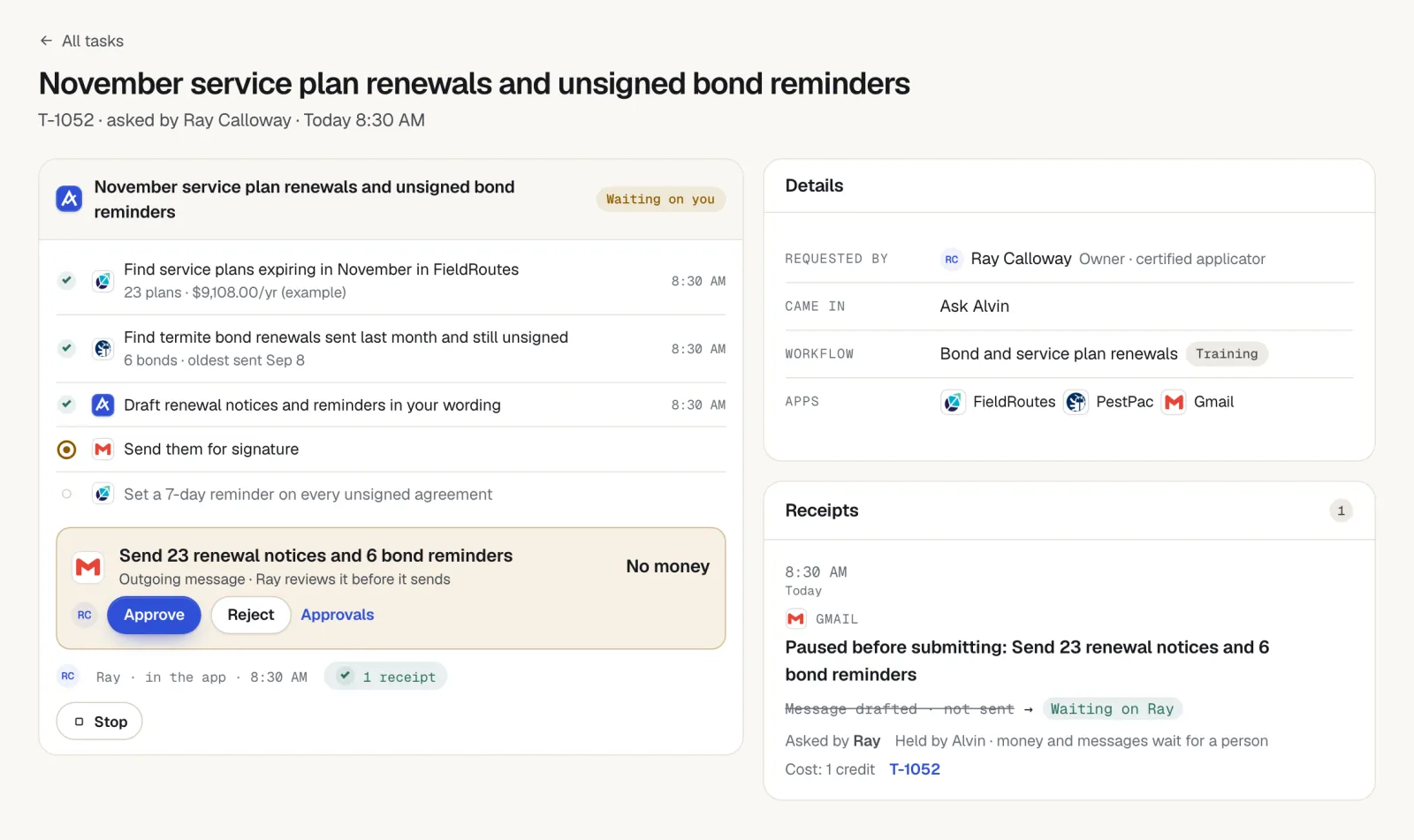
| Holds the agreement for approval, then sends it from your own email account | Approve each agreement before it goes to the customer |
| Follows up on unsigned agreements and files the signed copy on the account in FieldRoutes or PestPac | Decide whether service starts without a signature |
| Checks renewal dates on a schedule and drafts the renewal reminder for approval | Set renewal pricing and handle cancellation requests |
| Flags accounts with no agreement on file or a missing signature | Decide every question about coverage, guarantees and legal terms |
Alvin does not write contract terms and does not give legal advice. Alvin keeps the paperwork complete and on time, with a receipt for each step.
Frequently asked questions
What should a pest control contract include?
It should include the parties and service address, pests covered and excluded, the initial service, visit frequency, the re-service guarantee, customer responsibilities, term, renewal, cancellation, price and billing, and any disclosures your state requires. Both parties sign, and the customer gets a copy.
Is there a free pest control service agreement template?
The clause checklist in this article can be copied as a starting point. It is not a finished contract. State rules on renewal, cancellation and required disclosures differ, so have an attorney in your state review the final document.
Can a pest control contract auto-renew?
Often yes, but many states set rules for automatic renewal, such as clear disclosure before signing, a reminder before each renewal and a simple way to cancel. Check your state's consumer protection rules and have an attorney confirm your wording.
What is a re-service guarantee in pest control?
It is a promise to return and re-treat at no charge if covered pests show up between scheduled visits. A good clause states what triggers it, how quickly you respond, what the customer must do, and what is excluded.
Do I need a signed agreement for a one-time pest control service?
A short signed agreement is good practice for one-time work, since it records the scope, price and any guarantee period. Some states require written contracts or specific disclosures for certain services, such as termite work. Check with your state's pest control regulator.
Every account with a signed agreement on file.
Alvin fills in your template, chases the signature, files the copy and watches the renewal date. You approve what goes out.