How to price pest control jobs: a cost-per-stop pricing guide

To price pest control jobs, add up what one stop costs you (technician time on site, drive time, product, vehicle and a share of overhead), then divide by one minus your target profit margin. Price the first visit higher than the recurring visits, because it takes longer and uses more product. Alvin pulls the cost numbers out of your books and route software when you ask, and drafts price-increase notices for your approval.
On this page
- Pest control pricing starts with cost per stop
- How to work out your price in five steps
- One-time vs recurring pricing and the initial service fee
- Pricing specialty work by square footage or linear feet
- Why route density matters to price
- Yearly price increases
- What Alvin handles and what stays with you
- Questions
Pest control pricing starts with cost per stop
Most shops set prices by looking at what the company down the road charges. That tells you what the market will bear. It does not tell you whether you make money at that price. Five costs go into every stop:
- Tech time on site. Minutes at the property times the technician's loaded hourly cost (wage plus payroll taxes, workers' comp and benefits).
- Drive time. Paid minutes between stops. This is the cost most owners undercount.
- Product. What gets applied or installed on a typical visit, at your purchase cost.
- Vehicle. Fuel, insurance, maintenance and the truck payment, spread across the stops that truck runs.
- Overhead. Office pay, software, licensing, insurance, rent, marketing and the owner's salary, divided by total stops in the month.
How to work out your price in five steps
- Find your loaded labor rate. Take a technician's total yearly cost to the company and divide by the hours actually paid.
- Time a real route. For two weeks, record minutes on site and minutes driving for each stop type. Use averages, not the best day.
- Add product and vehicle. Divide a month of product purchases and truck costs by the stops completed that month.
- Spread overhead. Divide a month of overhead by the same stop count.
- Add profit. Divide total cost by one minus your target margin. For a 20% margin, divide by 0.80.
Here is a worked example for a quarterly general pest account. Every number below is an example. Use your own.
Scroll sideways to see every column.
| Line | Recurring quarterly visit (example) | Initial service (example) |
|---|---|---|
| Tech time on site at $38 an hour loaded | 30 minutes: $19.00 | 75 minutes: $47.50 |
| Drive time at $38 an hour loaded | 15 minutes: $9.50 | 15 minutes: $9.50 |
| Product | $7.00 | $18.00 |
| Vehicle | $6.00 | $6.00 |
| Overhead ($30,000 a month over 1,000 stops) | $30.00 | $30.00 |
| Cost per stop | $71.50 | $111.00 |
| Price at a 20% margin (cost divided by 0.80) | $89.38, so charge about $89 to $95 | $138.75, so charge about $139 to $149 |
If the going rate in your market sits below your number, the answer is in the cost lines: tighter routes, shorter stops or lower overhead. Matching a price that loses money on every visit only gets worse as you add customers.
One-time vs recurring pricing and the initial service fee
A one-time job has to carry costs that a recurring account spreads over years: the sales call, the setup in your software, a longer first treatment, and usually a callback inside the guarantee window. Price a one-time service well above a single recurring visit. Many shops set the one-time price so that signing up for a plan is the obvious choice.
For recurring plans, charge an initial service fee. The first visit is the longest one you will ever make to that house: full inspection, interior and exterior treatment, knocking down an active problem. In the example above it costs $111 against $71.50 for a regular visit. If you waive the initial fee as a promotion, know what you are giving away and tie the waiver to a minimum term in the service agreement.
Then pick the billing shape. Per-visit billing is simple. Monthly billing on a card smooths your cash flow and the customer's budget; the yearly total is the same four visits divided by twelve.
Pricing specialty work by square footage or linear feet
General pest plans price well by home size bands. Specialty work needs a unit that tracks labor and product:
Scroll sideways to see every column.
| Service | Common pricing unit | What moves the price |
|---|---|---|
| Termite liquid treatment | Linear feet of foundation | Slab vs crawl space, drilling, label rate for the product |
| Termite bait system | Linear feet, which sets station count | Install price plus a yearly monitoring fee |
| Attic or crawl space work | Square feet | Access, clearance, removal of old material |
| Rodent exclusion | Entry points or linear feet sealed | Roof height, materials, follow-up trap checks |
| Bed bugs | Per room or per square foot | Treatment method, prep, number of follow-up visits |
| Mosquito service | Lot size bands | Vegetation, standing water, visits per season |
Build each unit price the same way as a stop: hours, product at the label rate, vehicle, overhead, then margin. Measure on site or from a property report, and write the measurement on the estimate so the customer and the technician see the same number.
Why route density matters to price
Route density is how many stops a technician completes per hour of driving. It changes cost more than any other single lever. In the example, cutting the drive between stops from 15 minutes to 6 drops labor per stop from $28.50 to $22.80. The truck burns less fuel, and the technician fits more stops into the day, so overhead per stop falls too.
That gives you room to act on it. Offer a better price to a neighbor of an existing customer when the visit lands on the same route day. Charge more, or add a trip charge, for the lone account 25 minutes past the edge of your area. Clean routes also make billing easier, as covered in pest control route billing.
Yearly price increases
Wages, product, fuel and insurance rise every year. A plan priced three years ago is priced for costs you no longer have. Rerun your cost per stop once a year, and raise prices in small, regular steps instead of one large jump after several flat years.
Check each customer's agreement first: many set how and when the price can change and how much notice is owed. Send the notice in writing ahead of the renewal date, state the new price and the date it starts, and keep it short. Review your longest-held accounts one by one, since they tend to sit furthest below your current rate.
This article is general information, not legal or tax advice. Whether pest control services are taxable, and what notice a price change needs, depends on your state and your contract.
What Alvin handles and what stays with you
| Alvin does | You do |
|---|---|
| Pulls labor, product and vehicle costs from QuickBooks and stop counts from FieldRoutes or PestPac when you ask for cost per stop | Decide the target margin and set the prices |
| Lists accounts priced below your current rate, with the date of the last increase | Choose which accounts get an increase and how much |
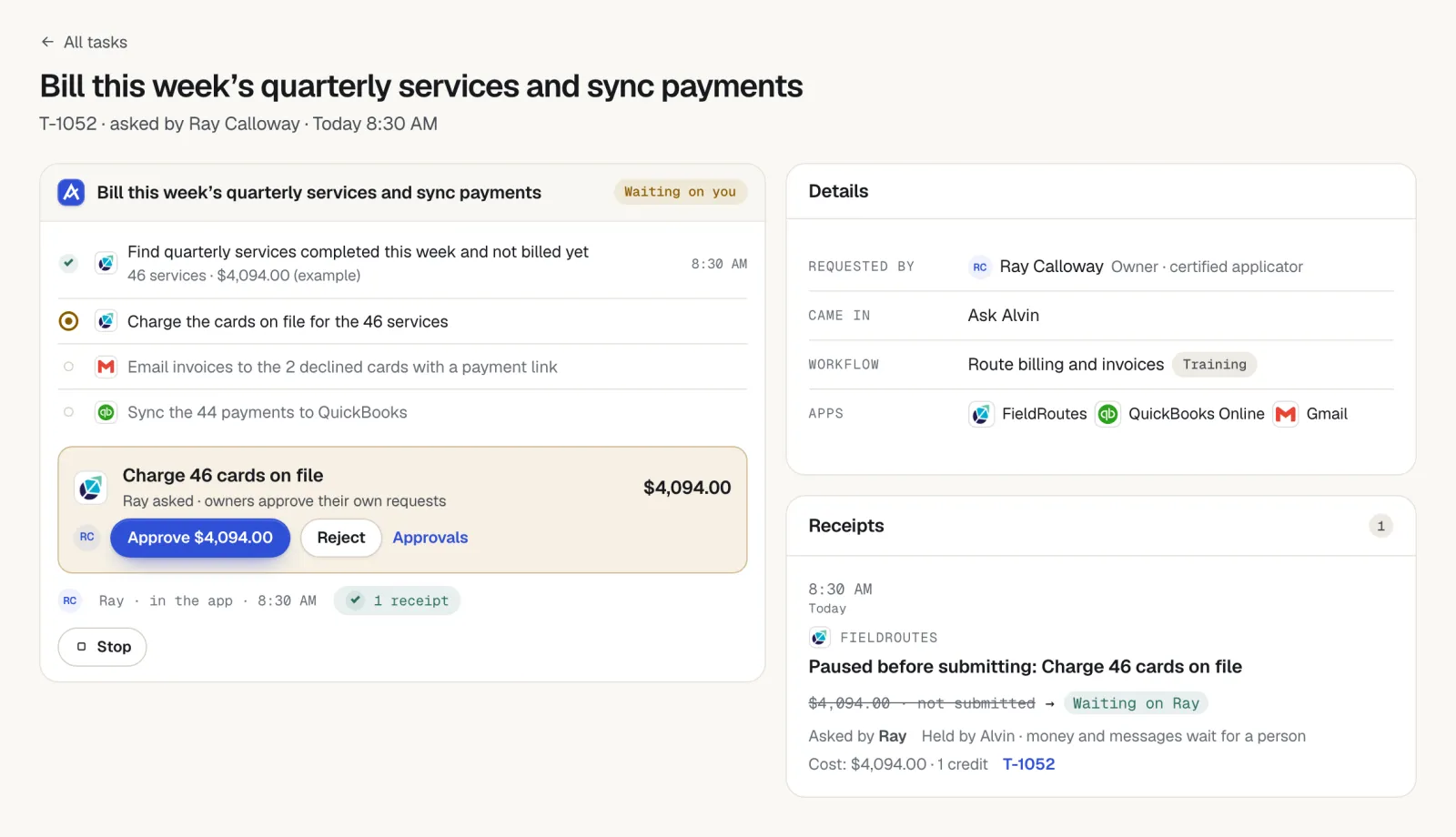
| Drafts the price-increase notice for each renewing customer and holds every one for approval | Approve, edit or pull each notice before anything is sent |
| Remembers your price bands, trip charges and per-foot rates so estimates use the same numbers | Measure the property and make every treatment decision |
| Keeps a receipt of who asked, who approved and what changed | Review the receipts when a customer asks what happened |
Alvin does the arithmetic and the paperwork. Pricing is your call, and anything about what to apply and where belongs to the licensed applicator.
To work out your own cost and price per stop, use the free pest control pricing calculator.
Frequently asked questions
How do you price a pest control job?
Add technician time on site, drive time, product, vehicle cost and a share of overhead to get your cost per stop. Divide that cost by one minus your target profit margin to get the price. For example, a $71.50 cost at a 20% margin gives a price of about $89.
Should I charge an initial fee for recurring pest control?
Yes, in most cases. The first visit takes longer and uses more product than a regular visit, so it costs more to deliver. If you discount or waive the fee, tie that to a minimum term in the written agreement.
How much more should a one-time pest control service cost than a recurring visit?
Enough to cover the sales time, setup, a longer treatment and a likely callback under the guarantee. Work out those costs the same way as a regular stop and add your margin. Many companies price it so the recurring plan is the better deal for the customer.
How is termite treatment priced?
Liquid termite treatments are usually priced by linear foot of foundation, and bait systems by the number of stations plus a yearly monitoring fee. Construction type, drilling and the product's label rate move the price. Measure the structure and write the measurement on the estimate.
How often should a pest control company raise prices?
Review your cost per stop every year and adjust in small steps. Check each customer's agreement for how price changes and notice work before you send anything. Give written notice ahead of the renewal date with the new price and start date.
Know your number before you quote.
Ask Alvin for your cost per stop, the accounts priced below it, and a draft notice for each renewal. You approve everything that goes to a customer.