How to price landscaping jobs and lawn mowing, with examples
Price landscaping jobs from your own cost per crew hour: add up wages, labor burden, equipment and overhead, spread that over the hours the crew is really on a property, then add your profit. Price lawn mowing as time on site times that hourly rate, and price installs as marked-up materials plus labor hours at the same rate. Alvin keeps your rates and material prices in one place and drafts estimates from them for a person to approve.
On this page
Work out your hourly cost per crew
Do this once per crew type (a two-person mow crew costs less than a three-person install crew with a skid steer). Pull the real figures from payroll and QuickBooks. The table uses example numbers for a two-person maintenance crew.
Scroll sideways to see every column.
| Cost | What goes in it | Example, per paid hour |
|---|---|---|
| Wages | Crew lead at $22 plus crew member at $18 | $40 |
| Labor burden | Payroll taxes, workers' comp, paid time off, benefits (example: 25% of wages) | $10 |
| Equipment | Truck, trailer, mowers, trimmers, blowers: payments, repairs, fuel, blades, replacement fund | $12 |
| Overhead | Office pay, owner's salary, insurance, shop rent, software, phones, marketing | $18 |
| Cost per paid crew hour | $80 |
To get the equipment and overhead figures, take the yearly total and divide by the paid crew hours you expect for the year across all crews.
Now account for drive time. You pay the crew for 8 hours, but they are on properties for maybe 6. The other 2 are loading, driving, fueling and dumping. Customers only pay for time on site, so those 6 hours carry all 8.
- $80 x 8 paid hours = $640 per day
- $640 / 6 hours on site = about $107 cost per on-site crew hour
Then add profit. For an example target of 15% net profit, divide by 0.85: $107 / 0.85 = about $126 per crew hour, or $63 per person per hour. That is this example crew's rate. Yours will differ, and tighter routes raise the on-site hours and lower the rate you need. See landscaping crew scheduling.
How to price lawn mowing by time on site
Mowing is priced by the minute, whatever the lot size says. A flat open half acre can be faster than a small yard with a gate, a trampoline and a steep bank.
- Estimate minutes on site for the whole crew: mow, trim, edge, blow. Walk it or measure it on an aerial map.
- Adjust for what slows you down: gates narrower than the mower, slopes, obstacles, corner lots with extra edging, bagging.
- Multiply by your crew hour rate. Minutes / 60 x rate.
- Check it against your minimum (below).
- Time the first three visits and correct the price at the next renewal if you guessed wrong.
Quote the customer a price per visit or per month, not an hourly rate. They are buying a mowed lawn.
How to price landscaping installs
Installs are materials plus labor plus the extras people forget.
- Materials at a markup. Plants, mulch, stone, soil, edging, fabric, plus delivery. The markup pays for sourcing, hauling, waste and plant warranty.
- Labor hours at your install crew rate. Count prep, install and cleanup. Use your own production rates from past jobs.
- Equipment and disposal. Rental, dump fees, hauling off sod and spoil.
- An allowance for the unknown on jobs with digging: roots, rock, buried debris, irrigation lines.
Markup and margin are different numbers. A 25% markup on a $100 material cost gives a $125 price, which is a 20% margin. Know which one you mean when you set a target.
Worked example: a weekly mow and a mulch install
Both use the example rate of $126 per crew hour from above. All figures are examples.
Weekly mow, the Garcia property. Two people, 20 minutes on site.
- 20 / 60 x $126 = $42 per visit
- At an example 30 visits a season, that is $1,260, or $180 a month billed evenly over 7 months
Mulch install, Mrs. Henderson's beds. About 800 square feet of beds at 3 inches deep. One cubic yard covers roughly 100 square feet at that depth, so 8 yards.
Scroll sideways to see every column.
| Line | Math | Price |
|---|---|---|
| Mulch | 8 yards at $38 delivered = $304 cost, plus 25% markup | $380 |
| Labor | 2 people, 4 hours on site (edge beds, weed, spread) = 4 crew hours x $126 | $504 |
| Disposal | Weeds and edging spoil, dump fee | $25 |
| Total | $909 |
That works out to about $114 per yard installed. Once you know that figure from your own jobs, you can quote simple mulch jobs per yard and save the full build-up for the odd ones.
Minimum charges
Small stops lose money without a floor. Set two minimums:
- A minimum per mowing visit. With the example rate, a 10-minute yard prices at $21, which does not cover pulling up, unloading and loading. An example minimum of $40 fixes that.
- A minimum for one-time work. A crew sent out for a single small job loses the drive both ways. An example minimum of two crew hours covers it.
Add a trip charge or a higher minimum outside your normal service area, or decline the work.
Fuel and price increases
Fuel belongs inside your equipment cost, so update that figure when prices move instead of guessing. If fuel jumps mid-season, a small flat fuel surcharge per visit is easier for customers to accept than a new price, as long as the agreement allows it and you remove it when fuel comes back down.
For yearly increases:
- Rerun the cost table every winter with new wages, insurance and equipment costs.
- Send renewal letters 30 to 60 days before the season with the new price in writing.
- Raise the underpriced properties first. Your time records show which ones run long.
- Give one sentence of reason and no apology: "Our labor and insurance costs went up, and the 2027 price reflects that."
The renewal terms should already be in your maintenance agreement.
What Alvin handles and what stays with you
| Alvin does | You do |
|---|---|
| Remembers your crew rates, minimums, markups and material prices, where the team can see and edit them | Set the rates, the profit target and the minimums |
| Pulls wages, equipment and overhead totals from QuickBooks when you rerun the numbers | Decide what counts as overhead and what you pay yourself |
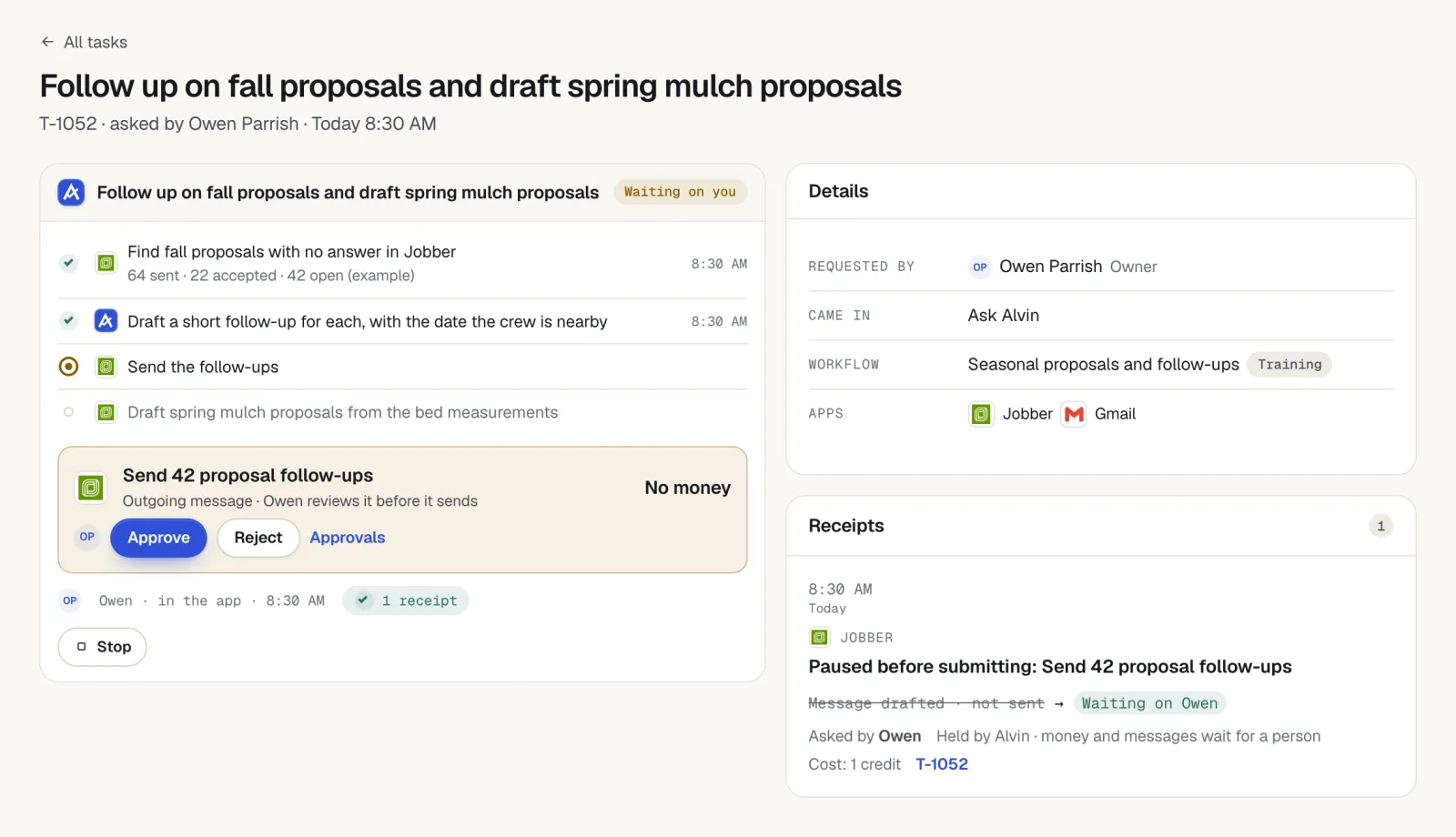
| Drafts estimates in your field service app from your rates and the measurements you give | Walk the property and judge the time on site |
| Lists properties where logged time runs over the time priced | Decide who gets an increase and how much |
| Drafts renewal and price increase letters for each customer | Approve every estimate and letter before it sends |
To price a stop from your own crew costs, use the free lawn mowing price calculator. For material quantities, use the free mulch calculator.
Frequently asked questions
How do you price landscaping jobs?
Add materials at a markup, labor hours at your crew hour rate, and equipment and disposal costs. Your crew hour rate comes from wages, labor burden, equipment and overhead, spread over the hours the crew is on site, plus profit. Check the total against past jobs of the same type.
How do you price lawn mowing?
Estimate the minutes the crew will spend on the property, divide by 60 and multiply by your crew hour rate. Adjust for slopes, gates and obstacles, and apply a minimum charge per visit. Quote the result as a price per visit or per month.
How much should I charge per hour for landscaping?
Enough to cover your own costs and profit, which differs by company and market. In this article's example, a two-person crew costing $80 per paid hour needs about $126 per on-site hour to cover drive time and a 15% profit. Run the same math with your own payroll and overhead.
Should I charge for drive time on lawn care routes?
Yes, but build it into your hourly rate instead of listing it on the invoice. Spread a full paid day over the hours the crew spends on properties. Add a trip charge only for work outside your normal service area.
How do I raise prices on existing lawn care customers?
Rerun your costs each winter and send the new price in writing 30 to 60 days before the season or renewal date. Start with the properties that take longer than they were priced for. Keep the explanation to one sentence.
Price from your own numbers.
Alvin keeps your rates and material prices where the whole team can use them, and drafts estimates and renewal letters for your approval. See what Alvin handles for landscaping companies.