Electrical contractor unpaid invoices and progress billing

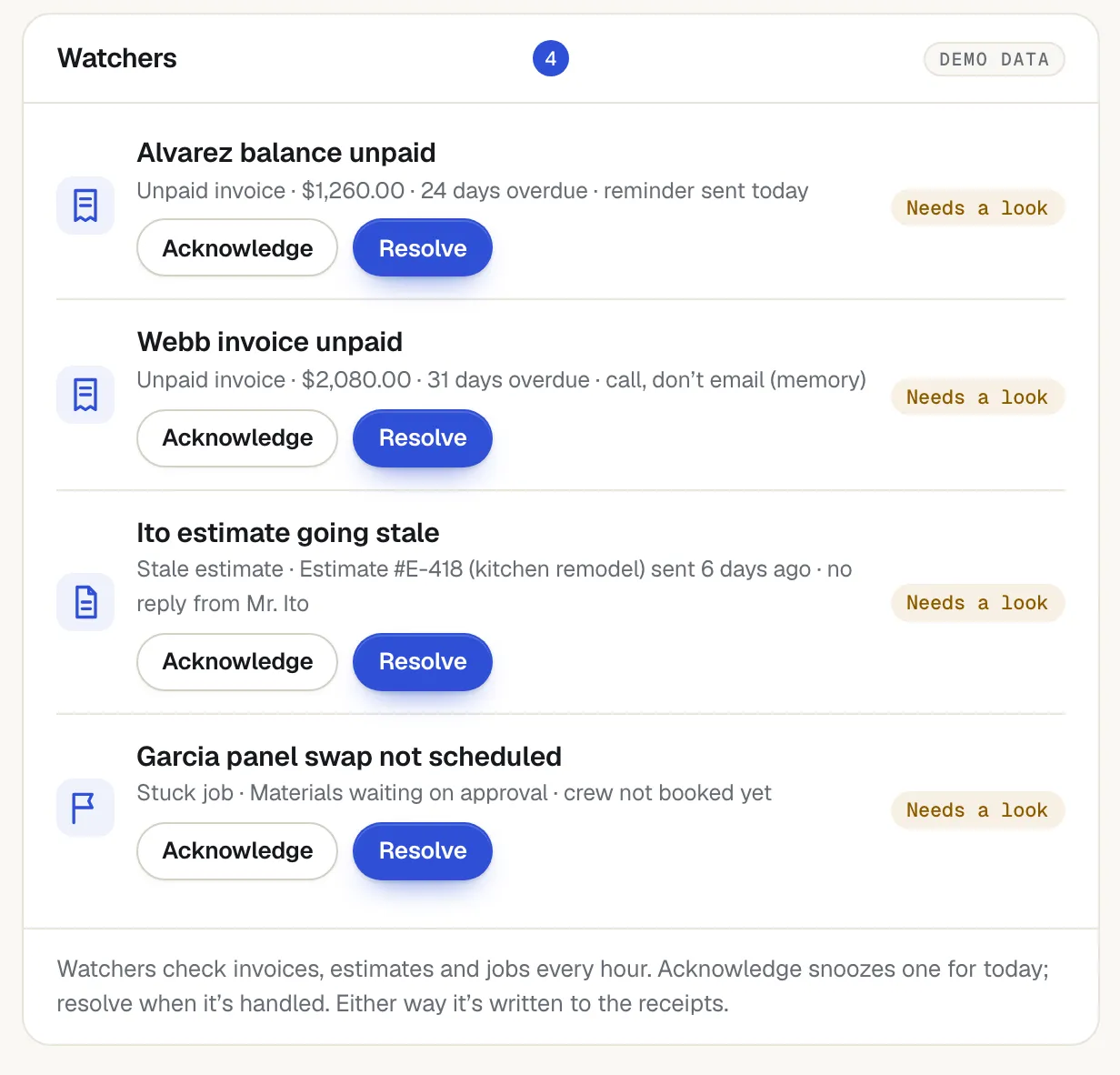
Electrical contractors cut unpaid invoices by billing in stages instead of once at the end: a deposit at signing, a progress bill when rough-in passes inspection, and a final bill at trim-out and final inspection. Each bill gets a follow-up at about 3, 10, 21 and 30 days past due, with the invoice number, amount and a way to pay. Alvin checks QuickBooks for overdue invoices on a schedule and drafts each reminder for a person to approve.
On this page
Progress billing for electricians: deposit, rough-in, final
The inspection schedule gives you billing points that the customer can see and cannot argue with. Rough-in either passed or it did not.
Scroll sideways to see every column.
| Milestone | What triggers the bill | Example split |
|---|---|---|
| Deposit | Signed estimate, before materials are ordered or a permit is pulled | 30% |
| Rough-in | Boxes set, wire pulled, rough inspection passed | 40% |
| Final | Devices and fixtures installed, panel labeled, final inspection passed | 30% |
| Change orders | Signed change order, billed with the next milestone or on its own | As priced |
The percentages are an example. Weight the deposit toward your material cost: a job with a large switchgear or generator order needs a bigger deposit than a labor-heavy rewire. Some states limit the deposit a contractor can take on residential work, so check your state's contractor board.
For a one-day service call, skip the stages and collect on completion. For a panel upgrade, deposit and final are usually enough. Use three or more stages for remodels, new construction and commercial fit-outs.
Put the terms on the estimate
Follow-up is easier when the customer agreed to the schedule before work started. The estimate or contract should state:
- Each milestone, what triggers it and the amount.
- When each invoice is due (on receipt, net 10, net 30).
- That the next phase is scheduled once the prior invoice is paid.
- How change orders are approved and billed. See handling electrical change orders.
- Who receives invoices, and who approves them if that is a different person.
- Any late fee or interest, if your attorney has confirmed it is allowed and worded correctly for your state.
Send the invoice the day the milestone is hit. An invoice sent two weeks after rough-in tells the customer you are not in a hurry either.
A follow-up sequence for unpaid invoices
Count the days from the due date, not the invoice date. Every message carries the invoice number, the amount, the job and a way to pay.
- 3 days past due: the reminder. "Hi Mr. Patel, a quick reminder that invoice 2217 for $4,800 (rough-in, Maple Street remodel) was due Monday. You can pay here: [link]. Let me know if you need anything from us."
- 10 days past due: the question. "Hi Mr. Patel, invoice 2217 for $4,800 is still open. Is there anything on the invoice you have a question about, or someone else who needs a copy? Trim-out is scheduled once this is paid."
- 21 days past due: the phone call. A person calls. Ask what is holding it up and get a date. Follow with one line in writing: "Thanks for the call. Confirming you will pay invoice 2217 by Friday the 14th."
- 30 days past due: the owner's letter. "Invoice 2217 for $4,800 is 30 days past due. Under our agreement, work on the next phase is on hold until it is paid. Please call me directly at [number] so we can get this resolved."
Stop the sequence the moment a payment posts or the customer replies. Chasing an invoice that was paid yesterday costs more goodwill than the reminder was worth. For more wording, see the payment reminder templates.
General contractors and property managers who pay slowly
Homeowners forget. General contractors and property managers have a process, and most late payments from them come from missing a step in it.
| Why it stalls | What to do |
|---|---|
| You missed the pay application cutoff | Ask for the monthly cutoff date and the required form at the start of the job. Put it on the calendar. |
| Paperwork is missing (lien waiver, insurance certificate, W-9) | Send the full packet with every invoice, not when asked. |
| The invoice went to the project manager, not accounts payable | Get the accounts payable email and a name. Copy both. |
| The GC is waiting to be paid by the owner | Read your contract for the payment clause before you sign. Ask your attorney how those clauses work in your state. |
| Retainage is being held | Track retainage as its own line and bill it on the date the contract allows. |
| The property manager needs a work order or PO number | Put the PO, unit and work order number on the invoice. |
Keep one list of every open commercial invoice with the contact, the cutoff date and the last thing each side said. Review it weekly.
When to stop work
Stopping work is the strongest tool you have before rough-in is covered and before the final is called in. Use it on purpose.
- Do not start the next phase while the prior milestone is unpaid, if your contract says so.
- Give written notice with a date: what is owed, when work pauses and what restarts it.
- Leave the site safe. No open boxes, no exposed live conductors, panels covered. Safety and code come before the dispute.
- Do not remove installed work or hold a customer without power to force payment.
Whether you may stop, and what notice you owe, depends on your contract and your state. Have an attorney review the clause once so the office can use it with confidence.
Lien rights exist and vary by state
Most states give contractors who improve a property the right to file a mechanic's lien when they are not paid. The rules differ a great deal: some states require a notice near the start of the job, each has its own filing deadline counted from your last day of work, and residential jobs often have extra steps. Miss a deadline and the right is usually gone.
What the office can do without a lawyer: record the first and last day on site for every job, keep signed estimates and change orders, and know your state's deadlines before you need them.
This article is general information, not legal advice. Lien rights, deposit limits, late fees and the right to stop work vary by state and by contract. Talk to a construction attorney in your state.
What Alvin handles and what stays with you
| Alvin does | You do |
|---|---|
| Checks QuickBooks on a schedule and lists invoices past due, by age and by job | Set the milestones, terms and reminder timing |
| Drafts the progress invoice when a milestone is marked complete | Approve every invoice and payment link before it goes out |
| Drafts each reminder with the invoice number, amount and job | Approve reminders, and make the day 21 phone call |
| Stops reminders when a payment posts or the customer replies | Handle disputes about scope or price |
| Keeps the GC packet together: invoice, waiver, certificate, PO number | Sign lien waivers and decide when to stop work |
| Puts overdue balances in the morning briefing, with first and last day on site | Talk to your attorney about notices and liens |
Alvin never holds or moves money. Payments go from your customer to your own accounts, and every reminder has a receipt showing who approved it.
To measure how long you wait to get paid, use the free days sales outstanding calculator.
Frequently asked questions
How should an electrical contractor handle unpaid invoices?
Bill in stages so no single invoice is large, and follow up on a fixed schedule: a reminder at 3 days past due, a question at 10, a phone call at 21 and a letter from the owner at 30. Include the invoice number, amount and a way to pay in every message. Pause the next phase of work if your contract allows it.
What is progress billing for electricians?
Progress billing means invoicing a job in stages tied to completed work. A common electrical schedule is a deposit at signing, a bill when the rough-in inspection passes and a final bill after trim-out and final inspection. The split depends on material cost and job length.
How much deposit should an electrician ask for?
Enough to cover the materials and permit you buy before work starts. As an example, many contractors use 30% on mid-size jobs and more when a large equipment order is involved. Some states cap deposits on residential work, so check your contractor board's rules.
Can an electrician stop work if a customer does not pay?
Often yes, if the contract ties each phase to payment of the prior invoice and you give proper written notice. The rules depend on your contract and state law. Leave the site safe, do not remove installed work, and ask an attorney before you rely on the clause.
Can an electrical contractor file a lien for an unpaid invoice?
Most states allow contractors to file a mechanic's lien on a property they improved. Notice requirements and filing deadlines vary by state and can be short. Track your first and last day on each job and talk to a construction attorney about your state's rules.
Know what is overdue every morning.
Alvin checks QuickBooks for unpaid invoices, drafts the reminder and waits for your approval. See what else Alvin handles for electrical contractors.